
Alcoholism: Understanding the Disease and Finding a Path to Recovery

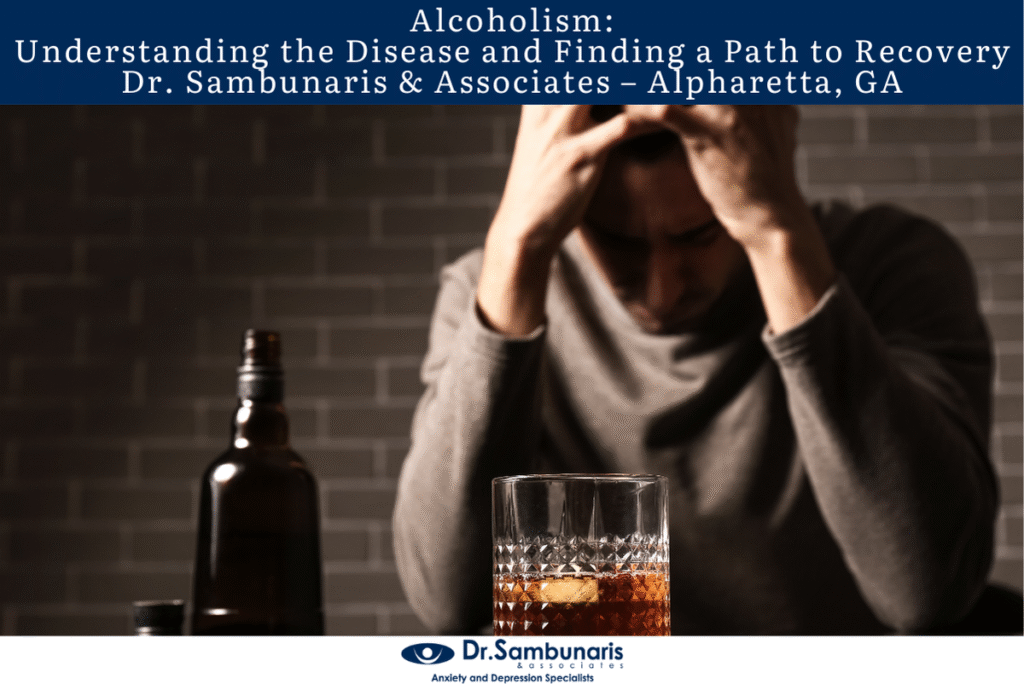
Distressed man with head in hands at a table with whiskey glass and bottle, banner text about alcoholism recovery above.

Dr. Sambunaris & Associates – Alpharetta, GA

Alcoholism is a serious, chronic disease that affects millions of individuals and families across the United States. It impacts physical health, mental well-being, relationships, and careers—but with professional help and evidence-based treatment, recovery is absolutely possible.

At Dr. Sambunaris & Associates, we specialize in the comprehensive care of patients struggling with alcoholism and co-occurring disorders such as anxiety and depression. Our approach is rooted in science, compassion, and long-term results.

What Is Alcoholism?

Alcoholism, also known as Alcohol Use Disorder (AUD), is a medical condition characterized by an inability to control or stop drinking despite the negative consequences it causes. It is more than just drinking too much—it’s a disease that changes the brain and behavior over time.

People with alcoholism often experience:

  • Cravings for alcohol
  • Loss of control over how much or how often they drink
  • Physical dependence or withdrawal symptoms
  • Tolerance (needing more alcohol to feel the same effect)

It’s important to remember that alcoholism is not a moral failure. It is a diagnosable and treatable medical condition.

Warning Signs of Alcoholism

Alcoholism can present differently depending on the person, but common signs include:

  • Drinking alone or in secret
  • Prioritizing alcohol over responsibilities
  • Memory blackouts or gaps from drinking
  • Neglecting personal appearance or health
  • Mood swings, irritability, or anxiety when not drinking
  • Withdrawal symptoms (sweating, tremors, nausea) when trying to quit

If you or someone you love is experiencing these symptoms, it may be time to seek help.

Our Approach to Alcoholism Treatment

At Dr. Sambunaris & Associates, our treatment programs for alcoholism are designed to address both the physical and psychological aspects of addiction. We combine the latest medical research with compassionate care to develop individualized treatment plans.

Our services may include:

  • Comprehensive Psychiatric Evaluation
  • Medication-Assisted Treatment (MAT) to reduce cravings and withdrawal symptoms
  • Behavioral Therapies, including Cognitive Behavioral Therapy (CBT)
  • Dual Diagnosis Care for patients with co-occurring anxiety, depression, or PTSD
  • Ongoing Support and Relapse Prevention Planning

Our mission is to empower patients to reclaim control over their lives and move toward lasting recovery.

Q&A: Alcoholism and Treatment Options

Q: How do I know if a loved one or I has a drinking problem?
A: If alcohol use is interfering with daily responsibilities, causing relationship issues, or leading to physical or emotional distress, it’s time to seek a professional evaluation. We can help you determine if it’s alcoholism and what steps to take next.

Q: Is alcoholism a disease or a choice?
A: Alcoholism is classified as a brain disease. While the initial choice to drink may be voluntary, over time alcohol can hijack the brain’s reward and control centers, making it incredibly difficult to stop without help.

Q: What role does mental health play in alcoholism?
A: A significant number of people with alcoholism also struggle with mental health conditions like anxiety, depression, or trauma. Treating both the addiction and underlying mental health conditions simultaneously is crucial for successful recovery.

Q: Can medications help me stop drinking?
A: Yes. FDA-approved medications such as naltrexone, acamprosate, or disulfiram can help reduce cravings and prevent relapse when used in combination with therapy.

Q: Is treatment confidential?
A: Absolutely. At Dr. Sambunaris & Associates, your privacy is a top priority. All consultations and treatment plans are strictly confidential.

Q: Do you offer support for families of alcoholics?
A: Yes. We understand that addiction affects the entire family. We offer family education and therapy options to support healing for everyone involved.

Start Your Journey to Recovery

If you or a loved one is struggling with alcohol use, you are not alone—and help is available. At Dr. Sambunaris & Associates, we’re committed to helping individuals understand their condition, regain control, and build a life free from addiction.

📞 Contact Dr. Sambunaris & Associates today for a confidential consultation.
Phone: (770) 817-9200
Address: 5755 North Point Parkway, Suite 256, Alpharetta, GA 30022
🌐 Website: https://drsambunaris.com

Recovery is not only possible—it starts with a single step. Let us help you take it.

Recent Posts

Depression in Men: The Signs Everyone Misses

It rarely looks like sadness. That is why it gets missed for years, including by the man experiencing it.

Table of Contents

  1. How Depression in Men Presents Differently
  2. Anger and Irritability as Symptoms
  3. Alcohol, Work and Other Cover
  4. Why Men Are Diagnosed Less Often
  5. The Suicide Statistic That Matters
  6. What Getting Help Actually Involves
  7. FAQs About Depression in Men
He has not said he is depressed. He has said he is fine, tired, stressed, and that work is a lot right now. He is drinking more, snapping at people, sleeping badly, and has stopped doing the things he used to enjoy. Depression in men frequently presents as irritability, physical symptoms, and withdrawal rather than visible sadness. That difference is why it is under-recognized, and it is why the consequences are more severe.

How Depression in Men Presents Differently

Depression in men more often appears as irritability, anger, physical symptoms such as headaches or digestive problems, risk-taking, increased alcohol use, working excessively, and withdrawal from relationships, rather than as the visible sadness and tearfulness commonly associated with depression. The underlying condition is the same. The expression differs, shaped substantially by what men are socialized to express and what they are not. That framing matters clinically. A screening question asking whether someone feels sad or hopeless will produce a no from a man who would answer yes to whether he feels irritable, disconnected, and unable to enjoy anything.

Anger and Irritability as Symptoms

Irritability is a recognized feature of depression and is frequently treated as a character issue rather than a symptom. What it tends to look like. A short fuse over small things. Disproportionate frustration in traffic or at work. Snapping at family, then guilt afterward. A persistent sense of being on edge. Why it happens is not fully settled, and one reasonable explanation is expressive. Anger is a permitted emotion for many men in a way that sadness is not, so distress routes through the available channel. The practical consequence is significant. A man presenting as angry gets responded to as an angry person. A man presenting as sad gets asked whether he is alright. Only one of those leads toward help. If someone close to you has become persistently irritable and withdrawn without an obvious cause, that pattern is worth asking about directly rather than managing around.

Alcohol, Work and Other Cover

Several behaviors both mask depression and worsen it. Alcohol. Drinking to switch off, sleep, or blunt feeling is common and is one of the most effective concealments available. Alcohol is a depressant and worsens the underlying condition, disrupts sleep, and makes any medication less effective. Overwork. Long hours provide structure, distraction, and a socially approved reason to be unavailable. It reads as dedication rather than avoidance. Withdrawal. Declining invitations, reducing contact, and describing it as being busy. This one is often what family notices first. Risk-taking. Driving faster, gambling, or other behavior that produces stimulation where nothing else registers. Physical complaints. Headaches, back pain, and digestive problems that bring men to a physician when mood would not. That last route is worth noting. Many men first present to primary care with a physical complaint, and depression is identified only if someone asks the right question.

Why Men Are Diagnosed Less Often

Several factors compound rather than one explanation. Presentation does not match the screening. Standard questions ask about sadness. Irritability and physical symptoms are less likely to be captured. Help-seeking is lower. Men consult healthcare less frequently overall, and are less likely to raise emotional symptoms when they do. The language does not fit. “Depressed” carries associations many men do not identify with. “Burnt out”, “stressed”, or “not myself” are more acceptable descriptions of the same experience. Clinicians ask differently. Research has found differences in how mood is explored with men and women in consultations. Alcohol obscures it. Problem drinking may be identified when the depression underneath is not. The result is a group with lower diagnosis rates and worse outcomes, which is the pattern in the next section.

The Suicide Statistic That Matters

This is the reason the recognition gap is serious rather than merely interesting. Men die by suicide at substantially higher rates than women across the United States, a pattern that has held consistently for decades and appears across most countries. Middle-aged and older men are at particularly elevated risk. The commonly cited explanation involves lower rates of diagnosis and treatment combined with more lethal methods. If you are having thoughts of suicide, call or text 988 now. The Suicide and Crisis Lifeline is free, confidential, and available 24 hours a day. You do not need to be in immediate danger to use it. If you are worried about a man in your life, ask him directly. Asking about suicide does not put the idea in someone’s head, and being asked plainly by someone who means it is frequently what allows a person to answer honestly. The Centers for Disease Control and Prevention publishes current US suicide data.

What Getting Help Actually Involves

Several assumptions keep men out of treatment and most of them are inaccurate. It is not lying on a couch discussing your childhood. Modern psychiatric assessment is structured and practical. Treatment often focuses on sleep, function, and specific problems. It does not automatically mean medication. Assessment establishes what is happening. Treatment is a discussion, and options include therapy, medication, or both. It is confidential. Employers are not informed. Specific limits exist around immediate risk of harm and are explained. It is not a permanent commitment. Many people are treated for a defined period and stop. Physical symptoms count. If sleep, energy, or physical complaints are what you can describe, start there. That is a legitimate entry point. A first appointment is a conversation and an assessment. Nothing is decided or prescribed without discussion.

FAQs About Depression in Men

Can depression cause anger rather than sadness? Yes. Irritability and anger are recognized features of depression and are more commonly the visible presentation in men. A short fuse, disproportionate frustration, and being persistently on edge can all be symptoms rather than character traits, particularly alongside sleep changes, withdrawal, and loss of enjoyment. Why do men drink more when depressed? Alcohol temporarily blunts emotional discomfort and is socially available in a way that discussing feelings often is not. It is a depressant, so it worsens the underlying condition, disrupts sleep, and reduces the effectiveness of treatment. It is one of the most common concealments and one of the most damaging. How do I talk to a man who might be depressed? Be direct and specific rather than general. Name what you have noticed, such as sleep, drinking, or withdrawal, rather than asking whether he is depressed. Ask about suicide plainly if you are worried, since asking does not increase risk. Offer something concrete rather than telling him to get help. Is depression in men treated differently? The treatments are the same, and the approach to engagement often differs. Framing around function, sleep, and specific problems tends to work better than framing around feelings. Coexisting alcohol use needs addressing alongside rather than afterward. Will treatment make me feel numb? Some people report emotional blunting on certain medications, which is worth raising with a prescriber since it often responds to a dose change or switch. Feeling like yourself again is the goal. Where medication produces flatness, that is a reason to adjust rather than to stop treatment entirely.

Book an Assessment

If sleep, drinking, irritability, or losing interest in things is what you can describe, that is enough to start with. Nothing gets decided at a first appointment except what is going on. Dr. Sambunaris & Associates treats depression in Alpharetta, Georgia. Book My Assessment or call (770) 817-9200. Reviewed by Angelo Sambunaris, M.D., with more than 20 years of clinical experience in mental health care and addiction medicine. If you are having thoughts of suicide or self-harm, call or text 988 to reach the Suicide and Crisis Lifeline, available 24 hours a day. This article is general information, not medical advice.  

How Antidepressants Work: Avoid the Costly Mistakes

Most people who stop an antidepressant do it in the window where side effects have started and benefit has not.

Table of Contents

  1. How Antidepressants Work
  2. How Long Before They Help
  3. The Main Classes
  4. Side Effects and What They Mean
  5. When Switching Makes Sense
  6. Coming Off Antidepressants Safely
  7. FAQs About How Antidepressants Work
You started a medication three weeks ago. You feel slightly nauseated, your sleep is odd, and your mood has not moved. That is roughly what week three is supposed to look like, and it is exactly when most people give up. Understanding how antidepressants work, what the timeline actually is, and which side effects settle makes the difference between a fair trial and a wasted month. This guide covers all three, plus when switching is the right call.

How Antidepressants Work

Most antidepressants increase the availability of neurotransmitters such as serotonin, norepinephrine, or dopamine in the brain. That change happens within hours of the first dose, when mood improvement typically takes weeks, which suggests the benefit comes from slower downstream adaptations rather than the immediate chemical change. Current understanding involves effects on neuroplasticity and brain circuit function rather than a simple chemical deficiency. The “chemical imbalance” explanation is a simplification that has been widely repeated and does not reflect current understanding. That does not mean antidepressants do not work. It means the mechanism is more complex than the shorthand suggests, and the honest position is that it is still being researched.

How Long Before They Help

The timeline is the single most useful thing to know before starting. Week 1 to 2. Side effects often appear. Mood usually unchanged. This is the hardest stretch and the most common point of stopping. Week 2 to 4. Early side effects frequently settle. Small changes may appear first in sleep, appetite, or energy rather than mood. Week 4 to 6. The window where response is usually judged at a therapeutic dose. Week 6 to 8 and beyond. Further improvement often continues. Full benefit can take longer. Two things commonly improve before mood does. Sleep and appetite. Noticing those is a reasonable early signal rather than nothing happening. Other people frequently notice improvement before you do. Depression distorts self-assessment, which is why a partner or friend saying you seem better is worth taking seriously.

The Main Classes

Different classes act differently, which is why one not working does not predict the next.
Class Common use Notable considerations
SSRIs Usually first-line Sexual side effects, early nausea common
SNRIs Depression, some pain conditions May raise blood pressure
Bupropion Depression, low energy Not typically associated with sexual side effects; not usually used where seizure risk exists
Mirtazapine Depression with insomnia or poor appetite Sedation and appetite increase are common
Tricyclics Older class, still used More side effects; used where newer options have not worked
MAOIs Rarely used Significant dietary and drug interactions
Choice depends on your symptom pattern, other conditions, other medications, and previous responses. Someone with insomnia and weight loss may suit a different medication from someone with fatigue and oversleeping. Family history sometimes informs the choice. A medication that worked well for a close relative is occasionally a reasonable starting point.

Side Effects and What They Mean

Distinguishing settling side effects from persistent ones prevents both premature stopping and unnecessary endurance. Usually settle within 1 to 2 weeks. Nausea, headache, jitteriness, sleep disruption, changes in appetite. Often persist and need discussion. Sexual side effects, ongoing sedation, weight change, emotional blunting. Report immediately. Rash, severe agitation, marked increase in suicidal thoughts, confusion, high fever with muscle rigidity, or unusual bleeding. Emotional blunting deserves specific mention. Some people describe feeling less of everything rather than less depressed. That is a recognized effect worth raising, since it often responds to a dose change or a switch. A specific caution applies to young people. Increased suicidal thinking has been observed in some children, adolescents, and young adults starting antidepressants, which is why closer monitoring is recommended in the early weeks. Report any increase in such thoughts immediately at any age.

When Switching Makes Sense

Several situations justify a change rather than persistence.
  • No meaningful response after 6 to 8 weeks at an adequate dose
  • Partial response that plateaus well short of remission
  • Side effects that persist beyond the settling period and affect daily life
  • A side effect that is intolerable from the outset
  • The diagnosis has changed on reassessment
Before switching, a prescriber usually checks whether the dose was optimized, whether you took it consistently, and whether something untreated is sustaining symptoms. Switching is not the only option. Augmentation, adding a second medication to boost the first, is a recognized strategy, as is combining medication with psychotherapy. The National Institute of Mental Health publishes patient information on depression treatment. Never switch or stop on your own. Some changes require cross-tapering and some combinations are unsafe together.

Coming Off Antidepressants Safely

Stopping needs planning, and this is where the most avoidable harm occurs. Abrupt discontinuation can produce discontinuation symptoms including dizziness, flu-like feelings, irritability, sensory disturbances sometimes described as brain zaps, and sleep disruption. Medications with shorter half-lives tend to produce more pronounced effects. Discontinuation symptoms are not the same as addiction. Antidepressants are not addictive in the sense of craving or dose escalation. The body does adapt to their presence, which is why gradual tapering is used. Timing matters. Stopping during a period of high stress, or before symptoms have been stable for a reasonable period, raises relapse risk. A taper is individualized. Some people need a much slower reduction than standard schedules suggest, particularly after long-term use. Never stop abruptly on your own. Speak to your prescriber and plan it together, including what to do if symptoms return.

FAQs About How Antidepressants Work

How long do antidepressants take to work? Typically 4 to 6 weeks at a therapeutic dose before response can be judged, with further improvement often continuing beyond that. Side effects usually appear before benefit does, which is why the first two weeks are the most common point of stopping. Sleep and appetite frequently improve before mood. Will antidepressants change my personality? They should not. Some people report emotional blunting, feeling less of both positive and negative emotion, which is a recognized effect and worth raising with your prescriber since it often responds to a dose change or switch. Feeling like yourself again is the goal rather than feeling different. Are antidepressants addictive? No, not in the sense of craving or needing increasing doses. The body does adapt to their presence, which is why stopping abruptly can cause discontinuation symptoms and why tapering is used. That is physical adaptation rather than addiction. What if the first one does not work? It is common, and it does not predict the next one. Different classes act differently. Options include switching class, optimizing the dose, augmentation with a second medication, adding psychotherapy, or reassessing the diagnosis. Non-response to two adequate trials is defined as treatment-resistant depression and has its own pathway. Can I drink alcohol on antidepressants? Alcohol is a depressant and can worsen symptoms and interfere with treatment. Some combinations carry specific risks, and certain medications interact more seriously than others. Ask your prescriber about your specific medication rather than assuming a general rule applies.

Review Your Medication Properly

Three weeks of side effects with no benefit is a reason for a conversation, not a reason to stop on your own. A review establishes whether the trial has been adequate. Dr. Sambunaris & Associates treats depression in Alpharetta, Georgia. Book My Medication Review or call (770) 817-9200. Reviewed by Angelo Sambunaris, M.D., with more than 20 years of clinical experience in mental health care and neuropharmacology. If you are having thoughts of suicide or self-harm, call or text 988 to reach the Suicide and Crisis Lifeline, available 24 hours a day. This article is general information, not medical advice. Never start, stop, or change medication without speaking to your prescriber.  

Treatment-Resistant Depression: Proven Next Steps

Two medications that did not work is not a personal failure. It is a clinical category with its own pathway.

Table of Contents

  1. What Is Treatment-Resistant Depression?
  2. Reasons Treatment Appears to Fail
  3. Options Beyond Another Antidepressant
  4. Where Ketamine Fits
  5. Questions to Ask Your Prescriber
  6. What Recovery Realistically Looks Like
  7. FAQs About Treatment-Resistant Depression
You have tried two antidepressants. Possibly three. One made you tired, one made you numb, and none of them touched the thing you went in for. By this point most people have concluded that something is wrong with them in particular. Treatment-resistant depression is a recognized clinical category rather than a verdict on you. It has a definition, known reasons it happens, and treatment pathways that differ from simply trying a fourth medication of the same type. This guide covers all three.

What Is Treatment-Resistant Depression?

Treatment-resistant depression usually describes major depression that has not responded adequately to at least two antidepressant treatments, each given at an adequate dose for an adequate length of time. The definition varies slightly between researchers and guidelines. The practical meaning is consistent, and it signals that the next step should be a change of approach rather than another medication from the same class. The phrase “adequate dose for an adequate length of time” carries most of the weight. Many treatments recorded as failures were never given a fair trial. Stopping at two weeks, staying on a starting dose, or missing frequent doses all produce an apparent failure that was really an incomplete trial. That distinction matters before anyone concludes the depression is resistant.

Reasons Treatment Appears to Fail

Several explanations look identical from the outside and need different responses. The trial was too short. Antidepressants commonly need 4 to 6 weeks at a therapeutic dose before response can be judged. Early side effects arrive well before benefit does, which is when many people stop. The dose was never optimized. Starting doses are starting points. Some people need considerably more. The diagnosis is incomplete. Bipolar depression, which is treated differently, is frequently first diagnosed as unipolar depression. Antidepressants alone can be unhelpful or destabilizing in bipolar illness. Something untreated is driving it. Thyroid dysfunction, sleep apnea, chronic pain, alcohol use, and vitamin deficiency all sustain depressive symptoms. Life circumstances have not changed. Medication does not resolve an ongoing situation that would depress anyone. A proper reassessment covers all five before adding another prescription. That reassessment is often the most useful appointment in the whole process.

Options Beyond Another Antidepressant

Once a fair trial has genuinely failed twice, several directions exist. Switching class. Moving between SSRI, SNRI, bupropion, mirtazapine, and other classes rather than trying a fourth similar drug. Augmentation. Adding a second medication to boost the effect of the first, which is a recognized strategy in treatment-resistant depression. Psychotherapy alongside medication. Combined treatment outperforms either alone for many people, and it is frequently missing from a medication-only history. Ketamine and esketamine. A different mechanism entirely, discussed below. Neuromodulation. Transcranial magnetic stimulation and, for severe cases, electroconvulsive therapy. Both are established options with substantial evidence. Treating what is underneath. Sleep apnea, thyroid problems, and substance use, where present. The National Institute of Mental Health publishes current information on depression treatment approaches. Nobody should be told they have run out of options after two medications. The list above is what remains.

Where Ketamine Fits

Ketamine works through a different mechanism from standard antidepressants, which is why it can help where they have not. Standard antidepressants primarily affect serotonin, norepinephrine, and dopamine systems, and typically take weeks to show benefit. Ketamine acts on the glutamate system and effects can appear far more quickly. Two forms exist. Spravato, an esketamine nasal spray, is FDA approved for treatment-resistant depression. Ketamine given intravenously or intramuscularly is used off-label for the same purpose. Realistic framing matters here. Ketamine is not a cure and does not work for everyone. Response is typically maintained through a course of treatment rather than a single session, and it works best alongside ongoing psychiatric care rather than instead of it. It is one option among several on the list above, not the end of the search.

Questions to Ask Your Prescriber

Five questions change the quality of the conversation.
  1. Was each medication I tried given at a full dose for long enough to judge?
  2. Has bipolar depression been considered and ruled out?
  3. Have thyroid function, sleep, and alcohol been assessed?
  4. What augmentation options apply to my situation?
  5. Which of the remaining options would you try next, and why that one?
The second question is the one most worth asking. Bipolar depression is commonly misidentified as unipolar depression for years, and it changes treatment substantially. Bring a written list of every medication you have tried, the dose, how long you took it, and why you stopped. That single document shortens the appointment and improves the decision.

What Recovery Realistically Looks Like

Two things are worth setting straight, since both cause people to give up. Improvement is usually partial before it is complete. Sleep improves, or appetite returns, or a morning feels marginally less heavy. Those are the early signals, and they are easy to dismiss when waiting for a dramatic change. Response and remission differ. Response means meaningful improvement. Remission means symptoms have largely resolved. Aiming for remission rather than settling at partial improvement is the right target, and it often takes longer. Track something concrete. Hours slept, days you left the house, whether you replied to messages. Depression distorts memory of how the last few weeks went, and a written record is more reliable than recall. Depression that has resisted treatment often still responds. It usually takes a different approach rather than more of the same one.

FAQs About Treatment-Resistant Depression

How many medications count as treatment-resistant? Usually at least two antidepressant treatments, each at an adequate dose for an adequate duration, without sufficient response. Definitions vary between guidelines. The important qualifier is that each trial was genuinely adequate, since many recorded failures were trials cut short or never fully dosed. Does treatment-resistant mean nothing will work? No. It means the standard first approach has not worked and a different strategy is needed. Options include switching class, augmentation, combined psychotherapy, ketamine or esketamine, and neuromodulation such as TMS. Many people who did not respond to early treatments respond to later ones. Could my diagnosis be wrong? It is worth checking. Bipolar depression is frequently first diagnosed as unipolar depression and is treated differently. Thyroid dysfunction, sleep apnea, and substance use produce or sustain depressive symptoms. A thorough reassessment is a reasonable step after repeated non-response. How long should I give a new antidepressant? Commonly 4 to 6 weeks at a therapeutic dose before judging response, though your prescriber may advise differently for your situation. Side effects often appear before benefit does. Never stop or change a dose without speaking to your prescriber first, since some medications require gradual tapering. Is ketamine a last resort? Not necessarily. It is one option among several for depression that has not responded to standard treatment, and it is often considered alongside augmentation or neuromodulation rather than after everything else has failed. Suitability depends on your history and is decided at assessment.

Get a Full Reassessment

Two failed medications is a reason to look again at the whole picture, including the diagnosis. That is a different appointment from a repeat prescription. Dr. Sambunaris & Associates treats depression in Alpharetta, Georgia. Book My Assessment or call (770) 817-9200. Reviewed by Angelo Sambunaris, M.D., with more than 20 years of clinical experience and over 30 years in clinical research. If you are having thoughts of suicide or self-harm, call or text 988 to reach the Suicide and Crisis Lifeline, available 24 hours a day. This article is general information, not medical advice. Never start, stop, or change medication without speaking to your prescriber.